The Credential Ecosystem and Where it Breaks Down
Credential trust rarely belongs to a single system or team.
By design, it is distributed across an ecosystem of independent organizations, each performing a specific role in defining, issuing, maintaining, or relying on credentials. Certifications, licenses, and attestations operate within this structure across nearly every regulated industry.
Organizations depend on credentials to determine who is qualified to operate inside their environments. Vendors rely on credentials to demonstrate compliance with regulatory and contractual requirements. Regulators and governing bodies rely on credentials to signal adherence to defined standards.
Trust flows through this ecosystem.
Visibility into that trust often does not.
Credential systems were designed to distribute authority. They were not designed to distribute visibility.
Understanding where the ecosystem breaks down requires understanding how credential systems function.
The Four Roles in Credential Ecosystems
Most credential ecosystems operate through four distinct roles.
Some organizations define what a credential represents. These organizations establish criteria that must be met to earn and maintain the credential.
Other organizations are authorized to audit against that definition and issue the credential once the requirements have been satisfied.
Some organizations earn the credential by demonstrating compliance with those criteria.
A fourth group of organizations relies on credential status to make operational decisions that carry risk.
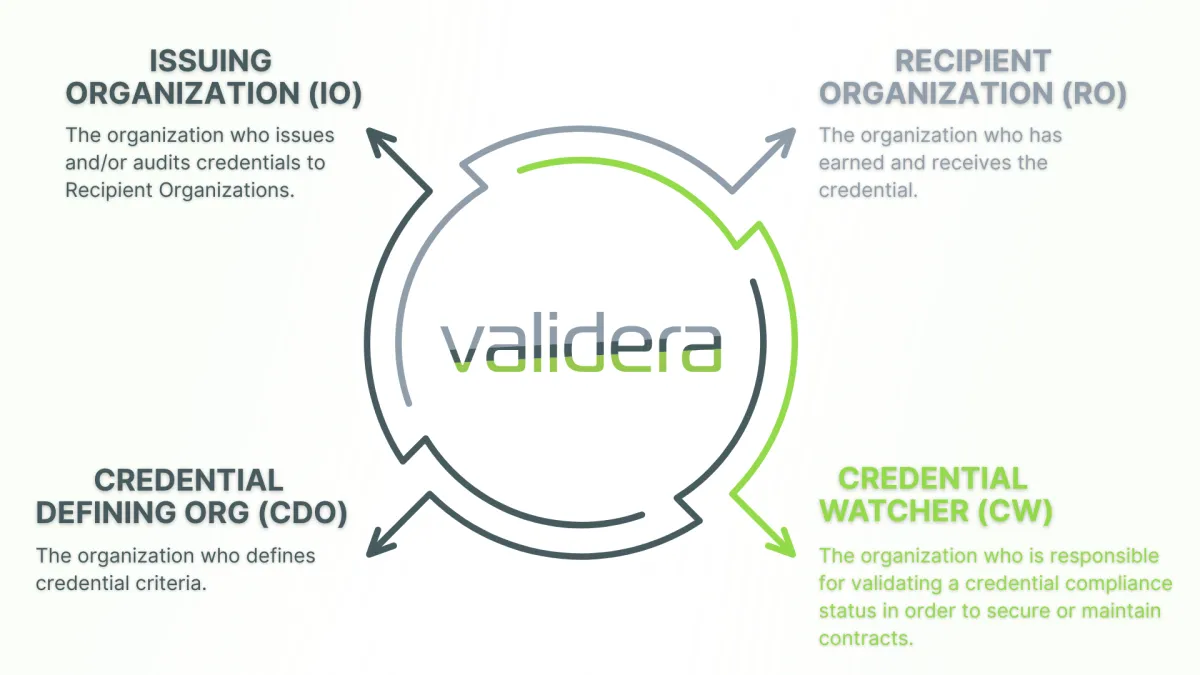
These roles can be described as:
Credential-Defining Organizations (CDOs) – establish credential requirements and standards
Issuing Organizations (IOs) – audit and issue credentials once criteria are met
Recipient Organizations (ROs) – earn and maintain the credential
Credential Watchers (CWs) – rely on credential validity to make operational decisions
This structure appears across industries regardless of the credential involved.
Healthcare providers rely on licensing bodies and certification authorities. Energy infrastructure operators depend on specialized certification programs for vendors and contractors. Defense contractors must confirm that subcontractors maintain certifications required under programs such as CMMC.
Each ecosystem distributes responsibility across these four roles.
Credential ecosystems function effectively at defining and issuing trust. Their weakness appears when organizations attempt to observe that trust over time.
The Recipient-Claim Model
Most credential ecosystems operate on what can be described as a recipient-claim model.
The organization that earns a credential is typically responsible for presenting evidence that the credential exists and remains valid. Vendors provide certification reports during onboarding. Contractors submit documentation when bidding for work. Service providers upload reports into trust centers or vendor portals.
The credential status is interpreted based on the documentation available at that moment.
Issuing authorities confirm credential status when audits occur. Between those audits, the issuing organization is rarely involved in how credential status is represented or relied upon across vendor ecosystems.
Recipient organizations become the primary source of credential evidence.
Documentation travels between organizations through email, procurement systems, document repositories, and trust portals. Each organization interprets the credential status using the information it has access to.
This approach has worked historically when verification cycles occurred infrequently.
Modern vendor ecosystems introduce new complexity.
Credential trust is often determined by the organization with the greatest incentive to claim it rather than the authority that issued it.
No single entity inside the ecosystem maintains a continuous, shared view of credential status.
The Absence of a Shared Source of Truth
The distributed nature of credential ecosystems creates a structural limitation.
Each participant sees a different view of credential status.
Credential-Defining Organizations establish the standards but typically do not track every instance where the credential is relied upon. Issuing Organizations verify compliance during audits but may not monitor how credentials are represented between those audits.
Recipient Organizations maintain documentation that demonstrates their certification status.
Credential Watchers depend on that documentation when making operational decisions.
Each group interacts with credentials from a different vantage point.
Visibility becomes fragmented across the ecosystem.
Procurement teams may rely on vendor-submitted reports. Compliance teams may track certification expiration dates inside internal systems. Security teams may depend on vendor questionnaires or trust portals.
These systems rarely communicate with each other.
Credential ecosystems distribute authority effectively. Visibility into credential status remains fragmented across every participant.
The organizations that carry the greatest operational risk frequently have the least direct control over credential verification.
Where the Ecosystem Breaks Down
The ecosystem does not break down in the definition or issuance of credentials.
Standards organizations and issuing authorities perform those roles effectively. Certification frameworks continue evolving to address emerging security, privacy, and regulatory requirements.
Breakdown occurs in the period between issuance and re-verification.
Historically, credential systems evolved around self-reporting and document exchange. A credential holder provides documentation confirming certification status. The relying organization reviews the documentation and records the credential in its systems.
Verification often occurs only when the credential is first submitted or when a renewal cycle occurs.
Operational environments rarely remain static during that time.
Certification scopes change. Vendors restructure operations. Subcontractors introduce additional dependencies. Issuing authorities occasionally suspend or revoke standing when conditions change.
These events may not be visible to organizations relying on the credential until the next verification cycle occurs.
Credential status can change long before the organizations relying on it become aware of the change.
Visibility into these changes remains limited within traditional credential systems.
The Position of Credential Watchers
Credential Watchers operate at the end of the ecosystem chain.
They rely on credential status to make decisions that carry operational and regulatory consequences. Vendor eligibility, system access, procurement approvals, and contractual compliance frequently depend on those credentials remaining valid.
Despite carrying the greatest exposure, Credential Watchers are often the farthest removed from the issuing authority.
Issuing Organizations verify compliance during audits. Recipient Organizations hold documentation. Credential Watchers must determine whether those credentials remain valid when decisions are made.
This dynamic produces a structural asymmetry.
Credential Watchers bear the operational risk associated with credential failure while lacking direct visibility into credential status changes.
The problem is often described within the language of third-party risk management.
Third-party risk represents a symptom rather than the underlying cause.
Credential status evolves faster than most organizations can detect it.
Visibility limitations inside the ecosystem produce the conditions that create risk.
The Emergence of the Credential Risk Gap
Fragmented visibility produces the conditions for what governance leaders increasingly recognize as the credential risk gap.
The credential risk gap appears when organizations rely on credential assumptions that cannot be continuously verified.
Recipient-claimed documentation provides evidence that a credential existed when it was submitted. Credential Watchers frequently depend on that evidence when making operational decisions.
Verification may occur weeks or months later when documentation is revisited.
Operational decisions occur continuously during that time.
Outdated information becomes the basis for trust decisions.
Organizations rarely operate this way intentionally. The ecosystem simply lacks infrastructure designed to provide shared visibility into credential status across all participants.
Emerging approaches to credential assurance are beginning to address this limitation. Platforms such as Validera illustrate how credential ecosystems can move toward issuer-confirmed visibility rather than recipient-claimed documentation.
Continuous credential assurance allows credential status to be observed across the ecosystem rather than reconstructed after problems occur.
Trust Requires Shared Visibility
Credential ecosystems play an essential role in establishing trust across industries.
Standards bodies define expectations. Issuing authorities verify compliance. Organizations earn credentials demonstrating that requirements have been met.
Operational environments have changed dramatically since most credential systems were designed.
Vendor ecosystems have expanded. Regulatory expectations have increased. Operational decisions relying on credential status occur continuously.
Trust decisions require visibility into the present.
Trust ecosystems cannot function effectively when the organizations relying on credentials are the last to know when those credentials change.
Strengthening credential governance requires systems capable of making credential status visible across the ecosystem as conditions evolve.
Shared visibility represents the foundation required to close the credential risk gap.
